
The hedge ratio is the whole game
A practical tour of six ways to estimate it and what choice signals about a stat-arb platform.
The single most important number in a pairs trade is the one most articles do not mention by name.
When people write about pairs trading online, they spend time on z-score, thresholds and pair selection. They rarely explain the actual ratio between the two legs. That ratio is the hedge ratio, usually written β, and getting it right is the entire technical problem.
Get the hedge ratio wrong and your spread is not actually mean-reverting. The rest of the strategy becomes the z-score of a random walk dressed up as research.
What β actually is
Two assets such as BTC perp and ETH perp trade at different price levels. Their prices move together but not one-for-one. To trade the relationship, you build a spread in the right proportion:
spread = ETH − β × BTC
β is how much BTC you short for every unit of ETH you go long, or vice versa. When β is right, the spread is a stable mean-reverting number. When β is wrong, the spread drifts with one leg and you stop trading the relationship.
The right β changes over time. A hedge ratio fitted once and held forever becomes stale surprisingly fast on crypto perps.
Six ways to estimate it
The literature offers six common estimators. Each optimises for something different, and knowing which one a platform uses tells you what that platform is optimising for.
OLS
Optimises for. Squared Y-residuals. Symmetric? No. Online? Approx. Use when. You want a quick first estimate and Y is plausibly the noisier leg.
TLS
Optimises for. Perpendicular residuals. Symmetric? Yes. Online? Approx. Use when. Both legs are noisy in comparable amounts.
Johansen
Optimises for. Cointegration likelihood. Symmetric? Yes. Online? No. Use when. You need more than two legs or want a formal rank test.
Box-Tiao
Optimises for. Predictability of the combination. Symmetric? No. Online? No. Use when. Mean-reversion speed is what you care about most.
Kalman filter
Optimises for. Posterior under a state-space model. Symmetric? Yes. Online? Yes. Use when. You need continuous online estimation as the hedge ratio drifts.
Half-life or ADF optimisation
Optimises for. A direct trading-relevant property. Symmetric? No. Online? No. Use when. You can validate the choice out of sample.
The continuity problem nobody warns you about
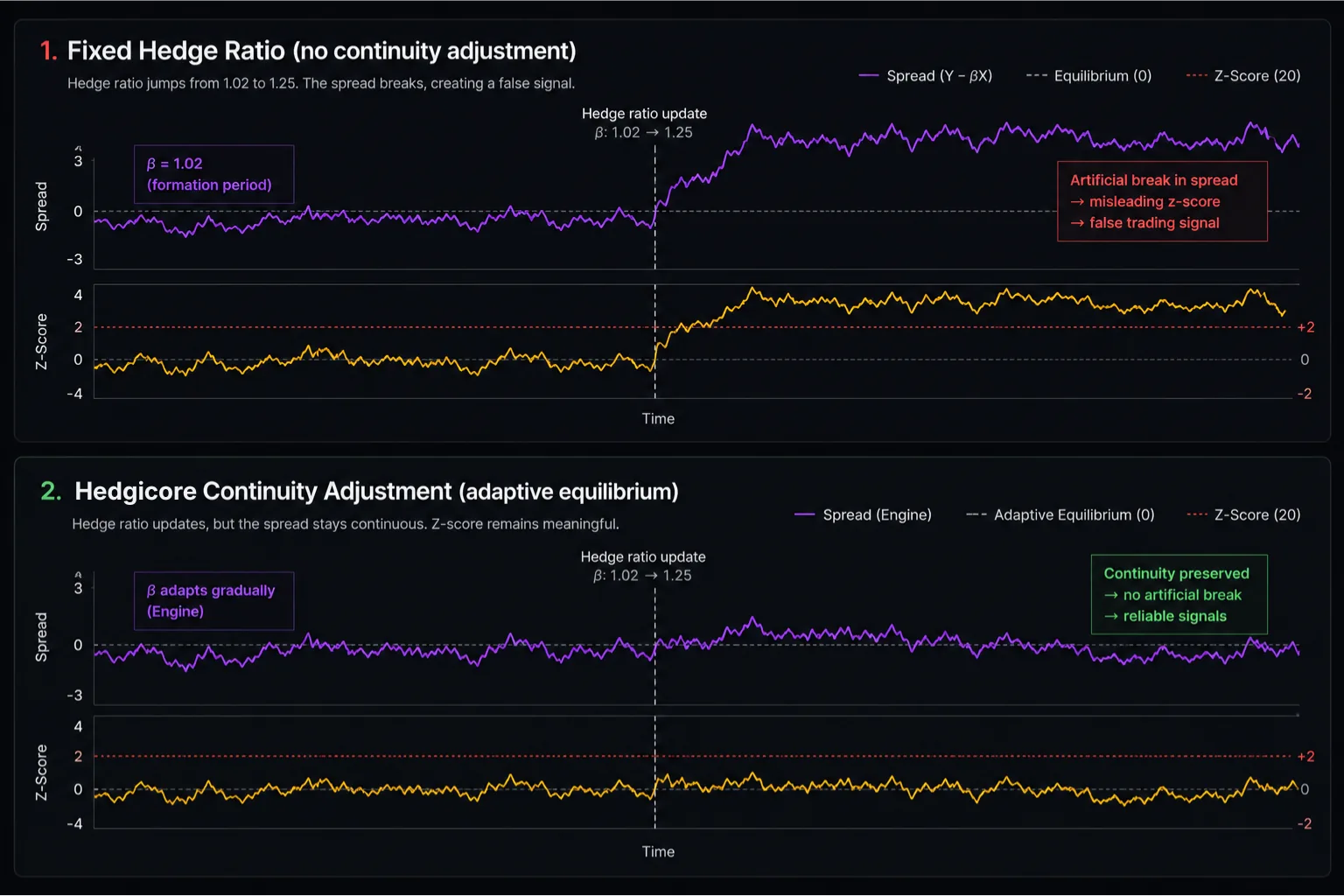
Every estimator except Kalman is a batch fit. You estimate β on a window, use it, then re-estimate it later. The moment β changes, the spread jumps. If you compute rolling indicators across that jump, the window straddles two different distributions and produces spurious signals.
There are four standard responses: continuous online estimation, fully static estimation, periodic re-estimation with no continuity adjustment, and periodic re-estimation with a spread offset that preserves continuity. Each has real tradeoffs. None of them is invisible.
How a platform handles this is one of the highest-information questions you can ask. The implementation paper covers all four responses in detail: Pairs Trading Implementation §3.5.
What this means for evaluating a stat-arb platform
Read the platform’s documentation and ask three questions.
- Which estimator? If the platform does not say, it is either hiding the answer or has not made the choice deliberately.
- Static, periodic or continuous? If it re-estimates periodically, how often? If it is continuous, what controls responsiveness?
- How is the continuity problem handled? If β updates periodically and the spread jumps, the displayed indicators around the jump can be misleading.
Hedgicore answers those questions at the design-principle level in the methodology paper. Read the methodology →
The takeaway
β is not an afterthought. It is the parameter the whole strategy is built on top of. A workflow that treats the hedge ratio as an afterthought is a workflow that has not understood what it is doing.
If you read one academic reference on this, read Vidyamurthy. If you read two, add Engle and Granger. If you want the comparative implementation treatment, the Hedgicore paper has it.
References
- Engle, R.F. and Granger, C.W.J. (1987). Co-Integration and Error Correction. Representation, Estimation and Testing. Econometrica 55(2).
- Johansen, S. (1988). Statistical analysis of cointegration vectors. Journal of Economic Dynamics and Control 12(2-3).
- Box, G.E.P. and Tiao, G.C. (1977). A canonical analysis of multiple time series. Biometrika 64(2).
- Kalman, R.E. (1960). A new approach to linear filtering and prediction problems. Journal of Basic Engineering 82(1).
- Elliott, R.J., van der Hoek, J. and Malcolm, W.P. (2005). Pairs trading. Quantitative Finance 5(3).
- Vidyamurthy, G. (2004). Pairs Trading. Quantitative Methods and Analysis. Wiley.
- Bonton AI, Hedgicore Research (2026). Pairs Trading Implementation. Hedge Ratio Estimation, Trading Rules and Backtesting. v1.0.
Hedgicore is a real-time pairs analytics platform powered by the Hedgicore Engine. Built by the team at Bonton AI.
Risk disclaimer: Hedgicore is an analytics platform. It does not execute trades or provide financial advice. All trading carries risk of loss.