
What statistical arbitrage actually is, in plain English
The short, opinionated guide to what it is, where it came from and why crypto is the harder version.
Statistical arbitrage is the trade where you stop caring which direction bitcoin goes.
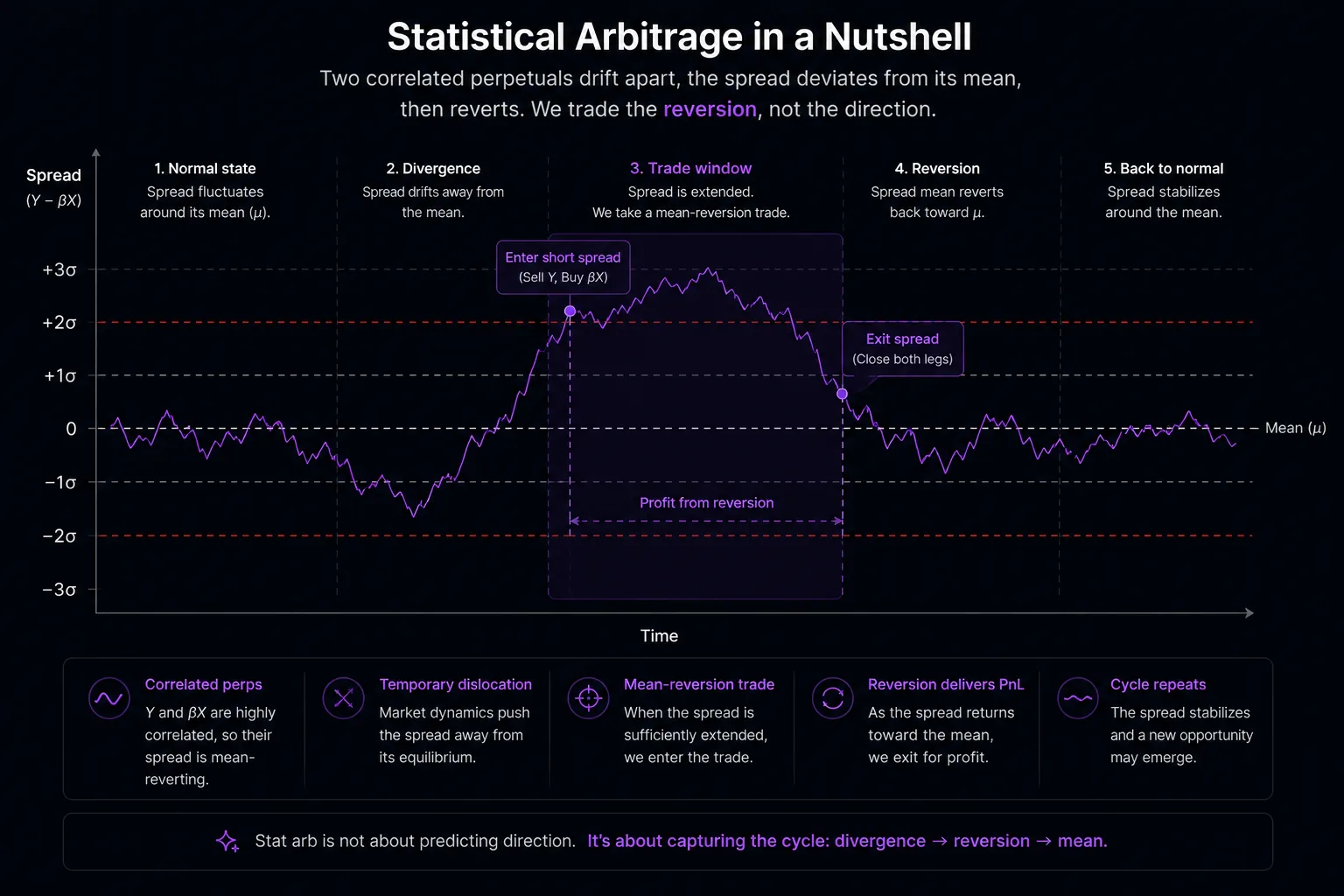
That part gets left out of most explanations. Every other strategy you read about online is some version of “the price will go up” or “the price will go down.” Stat arb is different. The price of this thing relative to the price of that thing will revert to where it usually sits. Direction stops mattering. The relationship is the trade.
Walk into a hedge fund in 1988 and you would find rooms full of people doing exactly this on equities. Walk into the same fund today and you would find a bigger room of people doing roughly the same thing with more math behind it. Statistical arbitrage built D.E. Shaw, Two Sigma and PDT Partners. The strategy is old. It still works.
The math is not hidden either. It has been public for forty years. What is hidden is the engineering: how you actually run this on live data without the model lying to you.
The setup, in one paragraph
You pick two assets that move together for a real economic reason. Coca-Cola and Pepsi if you trade equities. BTC and ETH if you trade crypto. The two prices live on different scales, so you combine them into a single number called the spread. Sometimes the spread drifts far from where it usually sits. When it does, you bet that it will come back. You go long the cheap leg, short the expensive leg and wait.
That is the whole strategy.
The work is in three places: picking the pair, computing the spread correctly and deciding when to enter and exit. Hedge funds have spent four decades improving those three steps.
The five families, briefly
The original public study matched pairs by normalised price distance and traded the divergence. Simple, model-free, scalable. It works less well now because the obvious pairs got mined first.
Cointegration is the math people actually use. Two assets are cointegrated if some weighted combination of their prices is stationary even though each price by itself drifts. Most modern stat arb is built on top of that idea. Hedgicore is too.
Stochastic-process methods model the spread as a continuous-time process, usually Ornstein-Uhlenbeck, and derive entry and exit thresholds analytically. Copula methods catch non-linear dependence. Machine learning mostly helps with pair selection at scale. Pairs trading is not one method. It is a toolbox.
Why crypto is the harder version
Everything above was developed on equities. Equity markets close. Equity pairs drift slowly. Equity volatility does not flip regimes in an afternoon. Crypto markets are open continuously, pair relationships shift in weeks rather than quarters, volatility regimes can change in a day and perpetual futures pay funding at intervals each exchange sets.
Each of these breaks something about the textbook implementation. A rolling z-score that works fine on equity data can fire constantly during a crypto volatility spike because the denominator has not caught up. A hedge ratio fitted in March can be wrong by June. A backtest that ignores funding can tell you a strategy made money when the exchange actually collected it back from you.
Where Hedgicore comes in
Hedgicore builds the spread you trade. An adaptive crypto-perp spread that handles the substrate problems above: hedge-ratio drift, funding flows and structural compatibility checks. That is the part of the platform that does not exist anywhere else.
On top of that spread, you use whatever technical indicator you already know: Z-score, MACD, Bollinger Bands, Stochastic, Nadaraya-Watson. They work the same way they work everywhere else; the difference is what they are computed on. A set of proprietary Hedgicore indicators called Stretch, Flow, Envelope, Pulse and Glide comes later.
The full description of how the Engine builds the spread and what the backtest models is in the methodology paper. Read the methodology →
A few questions worth asking
Is statistical arbitrage the same as pairs trading?
Pairs trading is the simplest case. All pairs trading is stat arb. Stat arb extends naturally to portfolios of three or more related assets.
Does stat arb still work?
Yes, on substrates where the modelling can be done correctly. Crypto perps are one of those. Equities still are too, though competition has eaten much of the easy alpha.
Do I need a PhD?
No. You need to understand cointegration well enough to know when a pair is qualified, a backtest that does not lie to you about fees and funding, and the discipline to follow rules.
Where do I read more?
The methodology paper is at hedgicore.com/methodology. The references below are where the math comes from.
References
- Engle, R.F. and Granger, C.W.J. (1987). Co-Integration and Error Correction. Representation, Estimation and Testing. Econometrica 55(2).
- Vidyamurthy, G. (2004). Pairs Trading. Quantitative Methods and Analysis. Wiley.
- Gatev, E., Goetzmann, W.N. and Rouwenhorst, K.G. (2006). Pairs Trading. Performance of a Relative-Value Arbitrage Rule. Review of Financial Studies 19(3).
- Pole, A. (2007). Statistical Arbitrage. Algorithmic Trading Insights and Techniques. Wiley.
- Avellaneda, M. and Lee, J.H. (2010). Statistical Arbitrage in the U.S. Equities Market. Quantitative Finance 10(7).
- Bertram, W.K. (2010). Analytic Solutions for Optimal Statistical Arbitrage Trading. Physica A.
- Krauss, C. (2017). Statistical Arbitrage Pairs Trading Strategies. Review and Outlook. Journal of Economic Surveys 31(2).
- Lopez de Prado, M. (2018). Advances in Financial Machine Learning. Wiley.
- Bonton AI, Hedgicore Research (2026). The Hedgicore Engine. A Methodology for Real-Time Statistical Arbitrage on Crypto Perpetuals. v2.0.
Hedgicore is a real-time pairs analytics platform powered by the Hedgicore Engine. Built by the team at Bonton AI.
Risk disclaimer: Hedgicore is an analytics platform. It does not execute trades or provide financial advice. All trading carries risk of loss.